Before the RFP:
What every enterprise travel manager needs to know before evaluating a modern TMC
A guide for senior travel leaders navigating vendor evaluation, internal stakeholders, and a changing content landscape
The moment you realize your travel program can achieve more is an exciting one. That realization alone puts you ahead of most. And now, your search for a new travel management company (TMC) can get underway!
If you’re considering a modern TMC, it’s important to know this isn’t a marginal upgrade. It’s a fundamentally different operating model. One defined by connectivity, automation, and integrity, built with full and direct content access and an online booking tool that travelers want to use.
This guide will help you seize the opportunity and choose well.
It will give you a framework for running an effective evaluation that holds up internally. One that speaks the language of procurement, finance, and leadership teams, and reveals how a vendor's operating model will perform when trips go according to plan and when they don’t.
By the end of this guide, you’ll know who needs to be in the decision-making room, what questions to ask potential vendors, and how to defend the modern TMC you ultimately recommend.
CHAPTER 1
Win the room before the first vendor call
Here's a pattern that comes up often in the RFP process: A new TMC evaluation kicks off with good intentions, vendors are invited in, demos are given, scores are tallied. Then, the process gets stuck somewhere in a procurement queue, or the finance team raises concerns that weren't addressed, or IT flags an integration dependency no one thought to include.
Time passes. And in the end, the status quo wins by default. Not because the case for change wasn't strong, but because the sheer scale of the project can overwhelm even the most well-intentioned groundwork.
Evaluating a modern TMC also introduces a wrinkle that traditional RFP processes don't always account for: the gap between what you've seen before and what's now possible. It's worth going in with an open mind about what “good” looks like, because the best modern platforms can operate in ways that legacy procurement scorecards weren't built to capture.
To make the most of your RFP experience, set the process governance up well before the first vendor call.
Here’s how.
Step 0: Assess your starting position
Step 1: Get the right people in the room
Step 2: Decide who owns what
Step 3: Agree on the problem you’re solving
Step 4: Build your scoring framework before vendors walk in
Step 0: Assess your starting position
Travel management sits in one of three places at most enterprises: Finance, Procurement, or HR. Where your role sits shapes who your natural allies are, what language and priorities will land, and where friction is most likely to come from. Understanding that before you walk into a stakeholder conversation will save you weeks.
If travel sits in Finance: You're already speaking the CFO's language, which is an advantage. But it can also mean the evaluation risks being reduced to a cost conversation before the full scope of the operating model is understood. Your job is to make sure the total cost of ownership, including the difficult-to-quantify manual work and not just the negotiated rate, is the lens from the start. Your likely friction points are Procurement (who will want to govern the process) and IT (who will have integration requirements that don't always surface until late).
If travel sits in Procurement: You have natural credibility in the RFP process, and stakeholders are more likely to trust the structure you set up. The risk is that the evaluation gets run like a traditional sourcing exercise (weighted heavily toward price and contract terms) when what you're actually evaluating is a modern travel operating model. Push for qualitative factors to have real weight in the scoring framework early, before the process is set.
If travel sits in HR: You're often closest to travelers’ experience and duty of care, which means you'll have strong instincts about what the program should feel like. The challenge is that finance and procurement stakeholders may not treat travel as a strategic priority until a business case lands in terms they care about. Build your coalition early and make sure you have a senior champion who can bridge to the CFO's office when the recommendation needs to land.
Prefer to receive a PDF to read?
Get a copy of this eBook delivered to your inbox.
Step 1: Get the right people in the room
The decisions you're making will touch systems and budgets across multiple teams: payment, expense, IT, HR, risk. The people who own those systems need to be part of the process from the start. The difference between a stakeholder who's a collaborator and one who becomes an obstacle is almost always timing, so be proactive.
Here's who typically needs a seat at the table, and why.
Finance: They own the payment infrastructure, ERP governance, and total cost of ownership conversation. Involve them early, so they help shape the evaluation criteria rather than question them later.
Procurement: They'll govern the RFP process regardless, so bring them in as a partner from the start. Set expectations clearly since they advise on process, not program design.
IT: Every TMC, whether legacy or modern platforms, requires integration decisions and enterprise security standards don’t pause for procurement timelines. IT can speak to your team's architectural requirements and constraints before you ask a vendor about theirs.
Security and compliance: Data handling, access controls, and audit trail requirements need to be defined before vendors are evaluated against them. Involve your InfoSec or IT security team early so their requirements shape the criteria, not the timeline.
HR and legal: Duty of care increasingly connects to both HR policy and legal exposure. These voices should be included to understand potential liability concerns and laws.
A senior champion: Someone who’s part of or has visibility into the executive layer who can help the recommendation land with the broader team.
Step 2: Decide who owns what
A clear roles and responsibilities chart isn’t bureaucracy for its own sake. It keeps the evaluation moving cleanly when trade-offs surface. Before your first vendor conversation, document roles and be specific about who decides, who advises, and who approves.
Disagreements about ownership tend to surface at the worst moment, like when a difficult trade-off lands and two stakeholders each assume the other will yield. Surfacing and solving for those tensions at the start, while stakes are low, is significantly easier than resolving them mid-evaluation under deadline pressure.
That way, when the final recommendation comes back with difficult choices (and it will), there’s no confusion about whose call it is.
Step 3: Agree on the problem you’re solving
Stakeholder alignment starts with a shared problem statement. Stay away from vague notions like, “we want to modernize travel.” That might be true, but the more specific and concrete you can be, the better.
For example:
Our agents spent 15 hours last month manually reconciling unused ticket credits that weren’t surfaced at booking. We need to identify and show credits automatically.
Finance asked us to explain a $40K discrepancy between the travel report and the card statement. We couldn’t do it without our data analysts spending hours reconciling. We need faster access to reliable data.
During the last major weather disruption, three travelers were stranded with no proactive outreach from our TMC. That can’t happen again.
These kinds of statements give your evaluation a grounded purpose. When stakeholders agree on the problems before they see vendor solutions, evaluations run faster, are scored more effectively, and are more likely to produce recommendations that’ll serve your team well.
Step 4: Build your scoring framework before vendors walk in
Once you have stakeholder alignment and a set of shared problem statements, define how you'll evaluate vendors. Before you start any demos, agree on your scoring criteria and each criterion’s relative weight. This will help your evaluation stay effective and objective, and it will remove temptation to adjust your criteria to fit your preferred solution after the fact.
A useful scoring framework accounts for both upfront costs and hidden ones:
Upfront costs like total cost of ownership, integration complexity, fare disparity between channels, implementation timeline, and ongoing fee structure
Hidden costs like manual workaround hours, unreliable data that requires reconciliation, unused ticket leakage, and agent dependency that drives up service costs
Both matter. A platform that looks cheaper on paper can easily cost more once you factor in the operational load it leaves on your team.
A useful reminder and starting point
It’s important to note the landscape you’re evaluating has changed from even just a few years ago. You’re faced with drastically different criteria introduced by a new generation of travel management companies.
These modern TMCs operate in fundamentally new ways, providing cost saving opportunities, greater program visibility, and a traveler experience that simply isn’t possible with traditional players.
This is a different end goal and it changes what a great RFP looks like. The strongest evaluations now go beyond confirming that candidates meet established standards. They're designed to identify which vendors represent a genuine step forward and which are optimized for a world that's already changing.
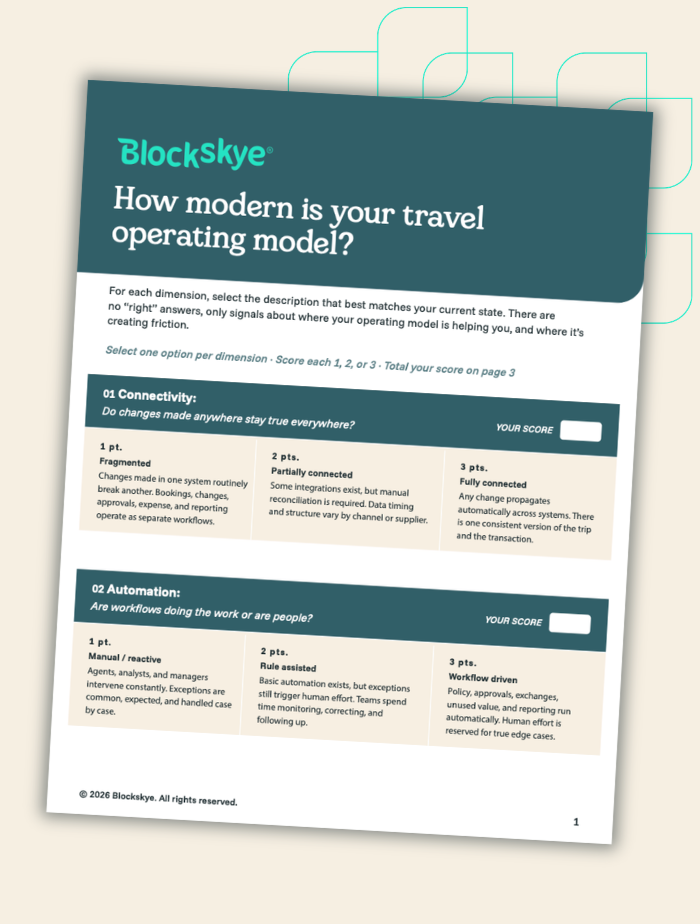
Before your first stakeholder meeting, run the Modern Travel Operating Model Scorecard.
It helps you articulate where your program sits today—service-dependent, patchwork, or connected—and gives finance and procurement teams a common reference point for what “better” really looks like.
Before you call vendors, ask yourself:
Where does travel sit in our organization and who owns payment, expense, IT, and risk?
Have those stakeholders all been briefed on this evaluation? Are they bought into the process?
Have we documented who decides, who advises, and who approves the final decision?
Can we articulate our top program pain points in concrete, measurable terms?
Do our key stakeholders agree on what problem we're solving before we ask vendors to solve it?
Have we defined our scoring criteria and their relative weights?
CHAPTER 2
Map the gaps your current program has normalized
You know the pattern: When something goes right in a travel program, it's usually the booking experience. When something goes wrong, it's almost always everything that comes after.
Traditional TMC models built and accumulated infrastructure layers separately, and over time, many programs have normalized the workarounds that resulted. A modern TMC connects them. Here's what that looks like in practice, and where your existing program may have adapted rather than solved the problem.
Booking
When booking works well, travelers find—and can compare—compliant options quickly. Prices and availability match or beat airline direct channels, building traveler trust. And the experience is genuinely good enough that travelers don't route around it.
Workaround to watch for: Travelers booking outside the tool because rates are better, content is missing, or the experience is slow. Every off-channel booking is a data gap and safety liability.
Payment
When payment infrastructure works well, you have real-time spend visibility across your program. Direct payments keep spend in-policy and authentication prevents out-of-policy transactions before they happen. Reconciliation is automated, and travelers earn loyalty rewards on company spend without extra steps.
Workaround to watch for: Multiple card programs, manual reconciliation steps, or expense platforms that require travelers to log what the system should already know—and travel and finance teams that spend hours unpicking reports and reconciling spend that doesn't add up.
Servicing
When servicing works well, self-service is the default. Travelers can make changes themselves and don’t have to call anyone for routine trip updates. When they do need support, agents and travelers are working from the same information, so context doesn't fall through the cracks and resolution is fast.
Workaround to watch for: Travelers calling agents for routine changes like seat selections, flight swaps, or simple re-routes. This drives up costs and creates unnecessary dependency. Over time, agent assistance becomes the workaround rather than the exception.
Expense
When expense works well, it’s automated. Trip spend flows directly into your ERP or expense platform, validated to project or team codes without manual entry, and the record is created by the trip itself in the moment, not by the traveler chasing receipts after the fact.
Workaround to watch for: Expense reports submitted weeks after travel with receipts that don't match the booking record. You and your finance team chase employees for documentation on spend that happened a month ago. This is a data integrity problem as much as a convenience one.
Data
When data works well, travel and finance teams work from the same reliable, real-time source of truth. The numbers are complete, consistent, and current. No footnotes or added context necessary. You can trust what you see and the insights you extract.
Workaround to watch for: Reports that have to be stitched together from multiple data sources to tell a complete story, and even then often arrive with a caveat. “This doesn't include the hotel yet,” or “we'll need to reconcile against the card statement.” Those caveats are symptoms of disconnected layers.
After reading this section, you might notice the questions you ask in an evaluation change. You aren't just asking whether a vendor offers bolt-on integrations. You're asking if a trip, and all its elements, are fully connected and synced in real time. And if different systems interact and do clients notice the overlap.
The gap between what vendors describe in a pitch deck and what they can demonstrate in a live workflow is often the most revealing part of the evaluation. Keep notes on what you find at each layer. When you reach Chapter 6, the specific gaps you identified here become the evidence that makes your qualitative scoring concrete and credible.
Questions to ask every vendor
For each layer, ask vendors to show you what happens when a trip changes, not just how a standard booking flows.
Booking: If a traveler searches the same route on your platform and on a consumer site or airline app, will they see the same fares? Which airlines are you connected to directly, and which are GDS EDIFACT only?
Servicing: A traveler's connection cancels at 9 p.m. Walk me through exactly what happens in the first 30 minutes. Who does what, and how much requires human intervention? Is the process the same for NDC bookings?
Payment: If a traveler changes a flight and the fare difference needs to be charged, how is that handled? Does it require manual reconciliation, or does payment update automatically?
Expense: If a trip is cancelled on day three of a five-day itinerary, what does the expense record look like 24 hours later? Does it update automatically, or does someone have to correct it?
Data: Show me a sample report for last month and walk me through it. What's included, what isn't, and where would I still need to reconcile against another source?
CHAPTER 3
Assess readiness for servicing, disruption, and real-world execution
When things go wrong in a travel program, they tend to go wrong fast. A weather system grounds an airport hub, three connections get missed, and suddenly 40 travelers at an offsite need to be rebooked before morning. How a TMC performs in that moment tells you far more about their operating model than anything you'll see in a demo.
Every experienced travel manager has a story of urgent escalations, and it’s easy to think of those moments as edge cases. But they're actually the moments that reveal whether a travel program's infrastructure is designed well enough to handle the real world at global scale, beyond just normal use cases.
That gap between what a TMC claims to handle and what the system actually handles when conditions are bad is one of the hardest things to assess in an evaluation. It doesn't show up in a demo. You have to ask for it.
Find out what disruption response looks like in practice
It’s helpful to ask a vendor about 24/7 coverage, a dedicated vs designated support team, and rapid response SLAs. Take it a step further and get specific to find out what a traveler actually experiences at 10 p.m. on a Sunday when their flight is canceled.
Ask vendors to walk you through a real, not a hypothetical, disruption scenario. Choose one that reflects the kind of travel your organization actually does. Consider:
How does the system identify affected travelers?
Who gets notified?
How many taps/clicks does it take to rebook a flight?
A good, modern TMC will answer the hypothetical with ease, describing a system that does the work: identifying affected itineraries, surfacing options, initiating outreach. A weaker TMC option will describe a team that manually handles it. Both may be needed, but the ratio matters.
It's also worth testing disruption scenarios across the range of traveler types in your program.
Your road warriors (frequent travelers comfortable with self-service) will tell you one thing about where the operating model holds up.
Your first-time or infrequent travelers, who may not know how to rebook independently and need more guidance, will tell you another.
And your VIPs and VVIPs, whose itineraries are often complex, high-stakes, and managed by executive assistants, will expose whether the platform can handle the kind of white-glove exception handling that leadership travel often requires.
Then there’s guest travel. Keeping non-profiled travelers informed and moving during disruption is just as important as your profiled employee travelers.
Ask vendors how the disruption experience differs across those profiles, and whether your program configuration can actually reflect those differences.
Make sure agent-assisted and self-service coexist
The best modern TMC programs don't just replace agents with automation. They reserve agents for situations where human judgment genuinely adds value: complex international itineraries, supplier negotiations, traveler care during significant disruption, and high-touch executive travel.
When routine changes require an agent request, something is wrong with the operating model. Agent dependency at scale is the opposite of a service feature. It's a significant design limitation.
Ask vendors directly: What's your online booking rate? What’s your digital trip completion rate, including changes, without agent assistance? What's your average response time for agent-assisted requests? Be skeptical of answers that can't be quantified. A modern TMC that's confident in its self-service capability will have these numbers ready.
How that balance plays out should depend on who's traveling.
Frequent travelers are typically comfortable with self-service and often prefer it. They want fast, frictionless changes they can make themselves without waiting for an agent. The platform needs to support that fluency.
Executives traveling with complex, multi-leg itineraries are a different case. Their trips are often managed by executive assistants who need to make changes on behalf of the traveler, require consistent profile preferences to be honored, and expect responsive, high-touch support when something goes wrong.
Ask vendors specifically how they handle EA-managed bookings, VIP profiles, and priority support queues.
Guests traveling for events, meetings, or site visits put your reputation on the line. Servicing flexibility needs to be baked into the platform, with policy and payment controls in place.
Understand how duty of care connects to the operating model
Find out how vendors capture location data and maintain it in real time, including for travelers in markets with local restrictions, regulatory requirements, or currency controls.
Ask how duty of care integrates with the third-party risk providers your organization already uses, working from the same trusted data your agents do. Ask what happens when a traveler is in a destination that shifts from low to high risk mid-trip.
The answers will tell you whether duty of care is a feature they've added or a capability that's genuinely built into how the platform operates.
Ask about 24/7 global servicing coverage
For enterprise programs with travelers in multiple geographies, coverage isn't just about time zones. It's about whether the operating model actually extends to the markets your travelers are in or whether coverage becomes patchy once travelers leave primary corridors.
Ask which markets are natively supported with wholly owned operations versus partner networks, and who is ultimately responsible when something goes wrong in each. Ask what happens when a traveler books an itinerary that crosses those boundaries. Ask whether a traveler in Singapore or São Paulo experiences the same quality of disruption support as one in Chicago.
Get specific about how the platform handles local nuances: market-specific regulations, visa and entry requirements, local currency payment options, and in-country restrictions that can affect rebooking options.
A global operating model that performs uniformly at the top line but struggles with local execution is one that will quietly create problems your travelers will notice before you do.
Questions that reveal execution readiness
What’s your online booking rate?
What’s your digital trip completion rate, including changes, without agent assistance?
What is your average agent response time?
How do you handle supplier disputes? What’s the escalation path?
How does your platform handle executive and VIP travelers whose executive assistants manage bookings on their behalf?
Can you show me a case where your servicing model failed, and what you changed as a result?
That last question is a useful filter. Vendors who can answer it honestly are usually the ones who've really thought this through.What’s your online booking rate?
CHAPTER 4
Don't let a polished demo hide an incomplete inventory
What your travelers see when they search for a flight depends entirely on where your booking tool pulls its fares from. That picture has changed significantly in recent years, and not all booking tools have kept up. Some programs are paying more (even losing traveler trust) without realizing the inventory gap is the cause.
This is one of the areas where a modern TMC can create the most immediate value. But it's also one of the easiest to look past in a demo, because an incomplete inventory can look identical to a complete one until you know what to ask or run a real flight search.
Airlines have been moving fares, content and new functionality into direct distribution channels that legacy booking tools can't or don’t fully access. If your tool isn't connected to those channels, your travelers may be searching a partial inventory without knowing it. Your program may be paying more, or missing options, as a result.
The GDS isn't the whole picture anymore
The traditional model of content distribution, where a global distribution system (GDS) served as the universal access point for airline fares and availability, no longer reflects how airlines actually sell.
Over the past several years, carriers have shifted a meaningful share of their inventory, including their lowest fares and ancillaries into direct distribution channels. This bypasses the traditional GDS EDIFACT pipe entirely and typically matches the airlines’ own website and mobile app.
That shift is driven largely by new distribution capability (NDC), an IATA standard that puts airlines in control of their inventory through direct APIs rather than legacy GDS infrastructure. NDC-connected fares often include pricing and options that simply don't appear in a traditional GDS search. GDSs are catching up with new supplier integrations, although restrictions persist and fares are typically subject to surcharges.
Instead, you need a TMC with NDC content and direct API integrations to access all relevant content and fares. But not all TMCs have invested equally in building those connections and the gaps aren't always visible in a demo.
Look for a modern booking tool with multi-channel inventory
In a demo environment, everything looks good. The real evaluation question is: What content is this tool actually connected to, and how does it vary by airline, market, and fare type?
Ask about NDC-connected airlines, GDS inventory, and LCC options too. Then, beyond air, ask about global hotel chains, car rental options, and rail providers—based on your program needs.
You shouldn’t need to be a content distribution expert to understand whether your program, and travelers, can get all relevant travel options. Your TMC should be your guide, with transparent advice.
Make sure the booking experience is unbiased and genuinely good
Even the most complete content access won’t matter if hidden bias influences search results and travelers don't trust or use the tool. And travelers won’t use tools that feel dated, slow, or show them something different from what they already found on their own.
Supplier commission plays an outsized role in traditional TMC economics. To maintain revenue and margins, many TMCs will prioritize search results based on how much commission they make, not by the relevance for your program or travelers. This undermines confidence in the platform, means you’re paying more, and pushes travelers elsewhere when they can’t quickly find what they’re looking for.
Then comes the user experience itself. Consumer booking tools have raised the bar in two ways: the quality of the interface and the completeness of what’s in it. Travelers compare what your corporate booking tool offers against what they can find themselves in two minutes on a consumer app. When those experiences diverge too far in terms of experience or content, leakage becomes inevitable and trust is lost.
Part of what makes modern TMC platforms competitive isn't just content access, it's the experience built around it. Evaluate both together.
There's a third dimension worth evaluating alongside content access and experience: serviceability. A traveler who books through an NDC channel and then needs to make a change mid-trip should never hit a wall. Direct API functionality varies widely by supplier and TMCs.
Ask vendors specifically how multi-channel inventory is serviced post-booking, not just how it's displayed at the time of search, to avoid downstream costs when manual intervention is needed.
Key questions on content and booking
Which live and roadmap airlines do you have direct NDC connections to?
For airlines where NDC content is available, how does it appear in the booking experience compared to GDS content? And can it be serviced?
Is content unbiased and unfiltered, prioritizing the program not the TMC?
How does the booking experience compare to leading consumer travel platforms?
What's your traveler adoption rate across your current client base?
CHAPTER 5
Run demos that reveal how the vendor’s operating model really works
By this point, you know what your current program gaps look like, what good servicing infrastructure looks like, and what complete content access looks like. The demo is where you find out which vendors can deliver on those dimensions and which ones only look like they can.
Most vendor demos are designed to impress. They follow a prepared flow, surface the strongest features, and stay in territory the vendor controls. If you let them run the session without interjection from you, you’ll come away with a good impression of their user interface and very little insight into how their operating model behaves when things don’t go to plan.
The advice in this chapter will help you take control of the demo process so that you get the demo you need to score the platform the way you want to.
Set the agenda before you show up
Send vendors your evaluation focus areas before the session. This makes it clear that you expect working demonstrations, not slides. If a vendor can't show something live, that's worth noting.
To make your demo scenarios as relevant as possible, pull your own data first:
your top carriers,
most-traveled city pairs,
preferred hotel chains,
and most common disruption types.
Ask vendors to demo against those specifics rather than a generic booking that shows their tool at its best. A vendor who performs well on your actual program profile is far more meaningful than one who looks good on a curated scenario.
Remember, not everything can be demoed or at least not without prep work. Sharing your preferences and use cases ahead of time gives the vendor plenty of time to show you what’s possible.
Ask every vendor to cover the same ground in the same order. Comparable sessions produce comparable scores. When each vendor has run their own flow, you end up comparing their best moments to each other, not their actual capabilities.
Bring the right people to each session
The stakeholders you identified in Chapter 1 should be in every demo. Not because they need to evaluate everything equally, but because each of them will be watching for different things. And when it’s time to defend the recommendation, they’ll be defending what they witnessed firsthand, not what you reported back to them.
Brief each stakeholder on their focus before the session so they know what to pay attention to:
Finance: Watch how payment flows when a booking changes or a trip is cancelled. Does reconciliation happen automatically, or does someone have to intervene? Does the vendor’s total cost framing hold up when you factor in implementation, ongoing fees, and administrative load?
Procurement: Watch whether the vendor’s claims are demonstrable or just described. Note anything that’s deferred to a roadmap or a follow-up conversation. Those are the assertions that are hardest to hold a vendor to contractually.
IT: Watch how data moves between systems and how quickly it updates. Ask about integration architecture, API dependencies, and what happens when a downstream system isn’t available. The answers will tell you a lot about implementation complexity.
Security: Ask how access controls are enforced, how the audit trail is maintained, and whether compliance documentation is readily available. Vendors who've thought it through will have answers ready. Vendors who haven't will tell you more than they intend to.
HR and legal: Watch how the vendor handles traveler visibility and duty of care, particularly for global itineraries or trips that cross into partner-serviced markets. What’s the escalation path if something goes wrong in a market they don’t natively support?
Your senior champion: Watch for the platform’s operating model credibility. Does the vendor talk about systems and workflows, or features and promises? Can they answer hard questions without retreating to slides? Executive sponsors who saw the demos are far more useful in a recommendation meeting than ones who didn’t.
(BONUS) executive assistants:
They don't need to be part of the demo, but it's worth understanding how they like to work before you go in. Executive trips tend to have the most scrutiny. If something goes wrong, you'll hear about it. Knowing how EAs prefer to book and manage travel can surface questions that other stakeholders won't think to ask: How does the platform handle profile preferences for VIP travelers? How does an EA make changes on behalf of an executive? What's the priority support path when a senior leader's trip disrupts?
Push vendors off their prepared flow
The most useful thing you can do in a demo is interrupt it. After all, you're the client and you need to confidently check your evaluation criteria to make an informed decision.
When a vendor shows you a booking, ask what happens when that booking changes. When they show you a report, ask where the data comes from and how quickly it updates after a disruption. When they describe automation, ask what still needs manual intervention.
What you’re looking for is the operating model, not just the interface. A strong vendor will answer those questions: how changes appear across systems, which data updates automatically, exception handling with clear ownership. A weaker one will describe what happens, defer to a roadmap, or say “your team would just manage that.” That last phrase is a red flag worth writing down.
Document what you see, not just what you hear
Vendor promises don’t belong in a scoring rubric. What a vendor showed you does. Keep notes that distinguish between what was demonstrated live, what was described verbally, and what was deferred to a later stage. Those distinctions will matter when you’re scoring qualitative factors in Chapter 6 and when a stakeholder asks you to justify a score.
For each vendor and each evaluation dimension, note:
What was shown live in the system
What was described but not demonstrated
What was deferred to a roadmap or a follow-up conversation
Any answer that couldn’t be quantified when you asked for a number
These notes are what your qualitative scores will be built on. They’re also what you’ll reach for in Chapter 6 when Finance or Procurement asks you to justify why one vendor scored higher than another on something that isn’t a line item.
Know the difference between strong and weak vendor signals
Strong vendors talk about systems, workflows, and constraints. They can show you where manual work disappears after a booking change, how data stays clean without manual reconciliation, and how exceptions are caught before they escalate. The operating model is visible in the demo itself, not described in a slide after it.
Weaker vendors only talk about features, roadmaps, and customization. They show a polished interface but can’t explain where the operational load goes. The demo looks good without revealing how the program runs day to day.
The vendor who understands the knock-on effect of how their platform operates, where there are gaps, and answers confidently under pressure is usually the one whose operating model is actually built the way they say it is.
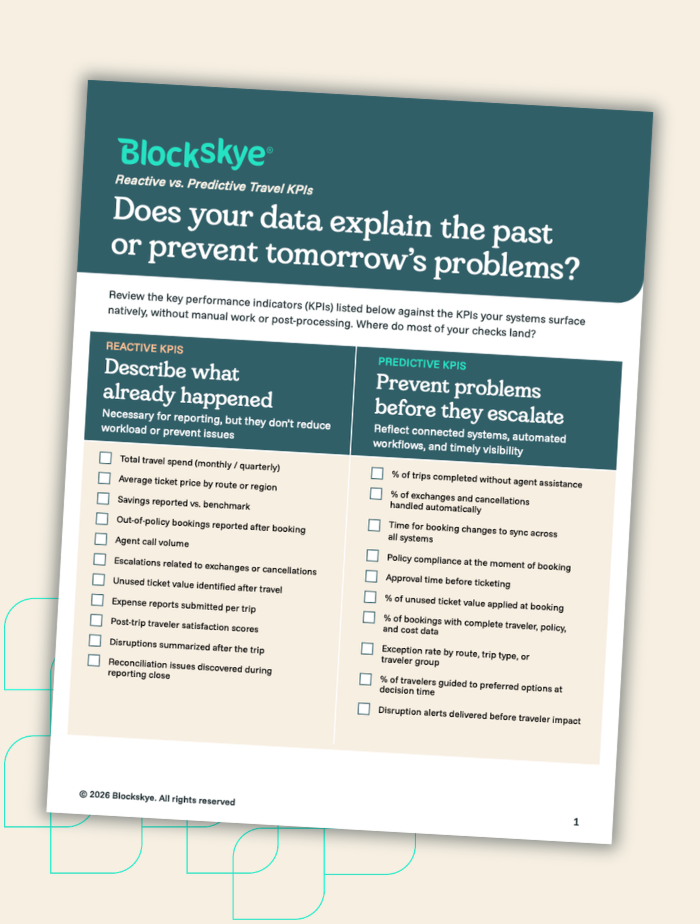
Use the Demo Preparation Guide
The Demo Preparation Guide covers six evaluation dimensions: connectedness, automation, data integrity, policy effectiveness, KPI visibility, and operational reality. Each section comes with specific questions and red flags for each. Bring it into every vendor session and use it alongside your scoring framework to keep observations consistent across vendors.
After each demo, ask yourself:
Did the vendor show me the operating model, or just the interface?
What was demonstrated live versus described or deferred?
Were there questions I asked that the vendor couldn’t quantify?
Did the right stakeholders attend, and did they come away with enough to score their dimensions?
Do my notes give me enough to justify a qualitative score if challenged?
CHAPTER 6
How to make (then defend) a decision
You've done the work. You've structured the demo process, gotten the right stakeholders involved, asked vendors the hard questions, and seen what their solutions look like when travel unexpectedly changes. Now you have to land on a recommendation and walk into a room with procurement, finance, and HR colleagues and present your pick in a way they’ll feel good about.
This chapter gives you strategies for bringing it all home effectively.
Refer back to the agreed-upon evaluation framework
If you followed the steps in Chapter 1, you already have an agreed-upon scoring framework in place. Now is the moment to use it:
First, score potential vendor solutions using it
Then, build your presentation using the framework as a foundation
Walk stakeholders through your scores methodically, category by category.
For quantitative factors like total cost of ownership, integration complexity, implementation timeline, ongoing fee structure, show the numbers and cite your sources.
For qualitative ones like traveler experience, service model maturity, data quality, disruption handling, don't rely on subjective impressions. Tie your scores to specific things you observed: a workflow the vendor couldn't demonstrate, a question they couldn't quantify, a scenario where the operating model held up or didn't.
Rigor here matters more than you might think. Qualitative scores are the ones that get challenged first, especially by stakeholders who weren't in the demos. “We felt their support experience was stronger” won't hold up in a room with Finance. “They couldn't tell us what percentage of changes are handled without agent intervention, and their competitor quantified it at 73%” will.
The goal isn't to eliminate subjectivity entirely. Some of what you're evaluating genuinely requires judgment. But make sure every score you present can be traced back to something that happened in the evaluation, not something you felt walking out of a demo call.
Reframe the cost conversation before your finance team does
Finance will often evaluate a travel program change through a single lens: What does it cost compared to what we pay now? That's a reasonable starting point, but it's incomplete.
Total cost of ownership in a travel program goes well beyond the fares, rates, and service fees. The hidden costs often exceed the visible line items. Think about manual workaround hours, data that requires reconciliation, unused ticket leakage, and service failures that pull your team or agents in to fix them. Finance may not be looking for these, which is exactly why you need to surface them explicitly.
Bring the total cost of ownership into your recommendation explicitly and with supporting evidence. This shifts the conversation from “is this more expensive?” to “what is the current model actually costing us?” That’s a much stronger place to make a case from.
Make Procurement a collaborator, not a gatekeeper
Procurement’s job is process integrity. When you make your recommendation, give them what they need to champion the decision rather than question it.
Come prepared to explain the scoring methodology, the weighting behind it, and how the evaluation was structured. Procurement needs to be able to defend the process, not just the outcome. Give them a clear picture of what a “connected operating model” means in concrete operational terms—reduced manual effort, cleaner data, fewer service exceptions—not just as a concept.
The more clearly you document the how of your evaluation, the less friction you’ll encounter at the finish line.
Ask for reference clients before you present
Before you finalize your recommendation, ask each vendor to provide reference clients that match your organization's profile: similar company size, comparable geographic footprint, and spend in the same range as yours. A reference from a 500-person domestic company tells you little if you're running a global enterprise program.
When you speak with references, ask what the first six months looked like, where the operating model performed as promised, and where it required more adaptation than expected. That honesty is more useful than a polished case study.
Make your recommendation in a CFO-friendly way
Finally, to land your recommendation well with a finance executive, translate program quality into business outcomes like reduced operational burden, more reliable data, lower cost of administration, and better compliance design. The layer-by-layer gap mapping you did in Chapter 2 is exactly the kind of evidence that makes those claims specific rather than general. Use it.Also, be sure to honestly address transition risk. Every CFO has seen a technology implementation go over budget or under-deliver. Acknowledge that risk, describe how you've evaluated for it, and show that the vendor's track record and implementation model have been part of the assessment.
Run this process well and you go beyond just selecting a vendor. You build a program architecture the company can grow into for the next three years—one that finance teams trust, procurement professionals can defend, and travelers want to use.
A strong recommendation includes:
✔ A clear set of problem statements, agreed upon by key stakeholders
✔ Scoring criteria that were defined and weighted before the evaluation began
✔ A documented map of current program gaps that grounds the case for change
✔ Vendor scores tied to specific demo observations
✔ Financial picture based on a total cost of ownership, not just servicing rate
✔ Quantitative factors well documented and sourced
✔ Qualitative factors documented with evidence, not preference
✔ Transition risk assessed and addressed directly
Before you present your recommendation:
Were all scoring criteria and their weights agreed on by stakeholders?
Is the finance team aligned on total cost of ownership, including manual effort, data gaps, and service failures?
Can you demonstrate qualitative factors with evidence from the evaluation?
Have you addressed transition risk directly, with specifics on how you evaluated each vendor's implementation track record?
Does the procurement team have enough visibility into the scoring methodology to defend the process, not just the outcome?
Tools to put this framework into practice
The framework in this guide is only useful if it's grounded in your specific program's reality. These tools are designed to help you do exactly that.
Modern Operating Model Scorecard
Find out where your current operating model is working and where it's creating friction by rating your program across six dimensions: connectivity, automation, data integrity, policy effectiveness, operational load, and transparency. Share your results with finance and procurement teams to build a shared baseline before evaluating vendors.
Modern Travel Demo Preparation Guide
Use this list of six question sets to reveal how a vendor's operating model actually behaves—when things change, when data needs to be trusted, when disruption hits. Use these to steer vendor conversations past polished UI and toward workflow reality.
See what this could look like for your team
If you're ready to evaluate what a modern travel operating model looks like for your program specifically, we'd be glad to walk through it with you. No sales deck. Just a real conversation about how your program runs today and where the program could carry more of the load.