
How TMC commissions shape adoption and compliance in corporate travel
If you’ve ever wondered why your carefully designed travel program looks great on paper but struggles with traveler adoption or travel policy compliance, you’re not alone. One of the most common reasons is also one of the least transparent: TMC commissions and the incentives behind them.
Most travel managers know that their Travel Management Company (TMC) gets paid in multiple ways. Fewer understand how those revenue models influence what travelers see, what gets recommended, and how service is delivered. And almost no one connects those dots all the way through to adoption, compliance, and total program cost.
This article does exactly that.
What are TMC commissions and why do they matter?
TMC commissions are payments a travel management company receives from suppliers or intermediaries such as airlines, hotels, GDSs, or distribution partners. They’re based on bookings, volume, or channel behavior. Incentive structures vary by program, platform, and region, but the underlying dynamics are common across managed travel.
TMC commissions matter because they influence incentives. Incentives influence behavior. And behavior determines whether travelers trust the program, adopt it, and stay in policy.
Commissions themselves are not inherently bad. The problem starts when TMC incentives are opaque, poorly disclosed, or misaligned with traveler experience and program goals.
When incentives are unclear:
Travelers lose confidence in content being shown
Adoption drops as employees book off-channel
Policy compliance erodes
Data quality degrades
Costs quietly increase
This is why understanding the TMC revenue model isn’t a simple finance exercise. It’s core to ensuring the best possible adoption and compliance.
How TMC incentives influence what gets booked
Every managed travel program sits at the intersection of content, technology, and service. Incentives influence all three.
What travelers see
Overrides in corporate travel (such as supplier incentives, productivity payments, or preferred placement sponsorships) can shape which options appear first, which fares are labeled “recommended,” and which suppliers receive emphasis.
Display logic is configurable and varies by platform, but even subtle steering affects traveler perception. When employees see content that doesn’t match what they find elsewhere, confidence in the program drops.
What counselors recommend
TMC agents are professionals, but they work within systems shaped by incentives. In edge cases like those with tight schedules, multiple comparable options, complex changes, economic signals can influence recommendations.
How service is delivered
Transaction-based fees and incentive structures can discourage proactive servicing or push travelers toward self-service paths that feel unsupported. That experience directly impacts trust and future adoption.
The adoption and compliance connection
Adoption and compliance don’t falter because travelers are careless or policies are too loose. They falter when the system feels misaligned with how people actually travel.
When travelers sense that the booking experience is distorted—that prices don’t match what they see elsewhere, “recommended” options feel arbitrary, or servicing creates friction—they question their trust in the program. Once trust erodes, behavior changes quickly. Employees book off-channel “just this once.” Assistants bypass the tool to save time. Managers approve exceptions to avoid escalation. Over time, those workarounds become the norm.
This is where TMC incentives quietly become a structural problem.
If the underlying TMC revenue model rewards certain channels, suppliers, or booking behaviors but the program is measured on adoption and travel policy compliance, there’s a built-in conflict. Travelers feel it. Even if they can’t articulate the economics behind it, they experience the friction firsthand, having to manipulate search results to find flights or hotels they know exist, seeing different prices when they book direct versus through the managed program, and questioning why a “recommended” option costs more than what’s available elsewhere. That frustration isn’t theoretical, it’s often the lived experience of frequent business travelers navigating systems layered with fees designed within legacy incentive structures.
Lower adoption then creates a second-order effect: incomplete data.
Once bookings fragment across channels, reporting loses accuracy. Policy enforcement weakens. Unused ticket value is missed. Finance sees spend creep without clear explanations. At that point, compliance becomes harder to regain not because the policy is wrong, but because the foundation isn’t trustworthy.
This is why adoption and compliance in managed travel aren’t enforcement problems. They’re alignment problems.
The transparency flywheel
Transparency isn’t a moral stance, it’s an operational advantage. When incentives are clearly disclosed and understood, travel programs start to behave differently. Travelers trust what they’re seeing. Travel managers can explain decisions with confidence. Finance teams rely on the data without second-guessing it.
That trust compounds. And it typically follows a predictable cycle:
Transparency builds trust
Trust drives adoption
Adoption improves travel policy compliance
Compliance creates cleaner, more complete data
Clean data enables better decisions about policy, suppliers, and spend
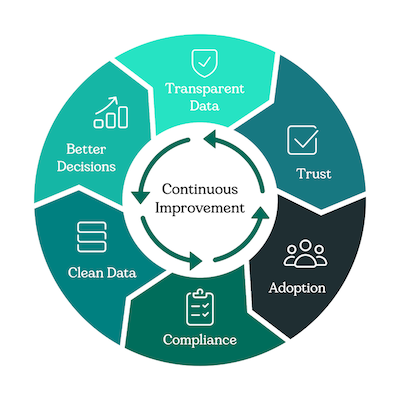
Those better decisions reinforce transparency, and the flywheel keeps turning.
The opposite is also true. Opaque incentives slow the flywheel down or reverse it entirely. When travelers believe recommendations are influenced by hidden economics, adoption stalls. When adoption stalls, data fragments. When data fragments, decisions get harder. Programs end up managing symptoms instead of causes.
The most resilient travel programs don’t try to force the flywheel to spin faster. They remove friction at the source by aligning incentives and making them visible.
Understanding TMC compensation models
Not all TMC compensation models are created equal and none of them are inherently wrong. Problems arise when compensation structures are hidden, poorly governed, or disconnected from program goals.
The table below outlines common compensation types and what they can influence. But the more important question isn’t which model you use, it’s how transparently it’s managed.
In well-aligned programs, travel managers can clearly answer:
Who pays whom
What behaviors are incentivized
How those incentives are governed
How outcomes are measured
Good programs don’t eliminate commissions, overrides, or incentives altogether. Instead, they make them explicit and auditable. Revenue streams are disclosed in plain language. Totals are reported on a predictable cadence. Display logic and “recommended” labels are governed jointly with the OBT. And performance is measured against adoption, in-policy booking, traveler satisfaction, and leakage, not just transaction volume.
When advice is clearly separated from incentives, trust improves. When trust improves, travelers stay in program. And when travelers stay in program, the data becomes reliable enough to actually manage the program strategically.
That’s what “good” looks like in practice—not a single fee model, but a transparent system where incentives reinforce the outcomes you care about.
Comparison table: TMC compensation types
| Compensation type | Who pays | How it's typically structured | What it can influence | What to ask your TMC | What to ask your OBT |
|---|---|---|---|---|---|
| Management fee / retainer | Buyer | Fixed monthly or quarterly fee | Clearer focus on outcomes | What's included vs extra? What outcomes are you accountable for? |
How adoption and in-policy are measured |
| Transaction fees | Buyer | Per booking, change, or refund | Push toward self-service | Full fee schedule What counts as a transaction |
What actions trigger transactions |
| Airline commissions | Airline | % of fare or fixed amounts | Bias toward commissionable content | Which airlines pay commissions in our program? | Whether ranking logic is normalized |
| Airline overrides / incentives | Airline | Volume or share-based payments | Carrier/channel steering | Are overrides tied to our program? | How "preferred" labels are governed |
| Hotel commissions | Hotel | Commission by rate/channel | Promotion of certain properties | Commission totals by chain/channel | How rates are sorted and flagged |
| Supplier marketing funds | Supplier | Sponsorships or placements | Visibility in booking flow | What funds exist tied to our program? | Where sponsored content appears |
| GDS incentives | GDS | Segment-based payments | Channel preference | Any productivity payments? | How multi-source content is combined |
| Ancillary fees | Buyer / Traveler | Add-on services | Perceived friction | Full catalog of add-ons | Where ancillaries appear in flow |
Curious how Blockskye handles these? Book a call. Our team would be happy to discuss.
How Blockskye approaches incentive alignment
Blockskye approaches incentive alignment by starting with infrastructure, not contracts.
Traditional TMC models sit on top of legacy intermediaries that were never designed for transparency. Incentives are layered across booking, servicing, payment, and reporting, often outside the buyer’s line of sight. Even well-intentioned partners struggle to make those economics fully visible because the systems themselves obscure them.
Blockskye removes that complexity by introducing direct, transparent connections across the travel lifecycle. Our platform is designed so that content can flow directly from suppliers. Servicing is unified across channels. Payment and expense data live in a single, trusted system. The result is a foundation where incentives are easier to disclose, easier to govern, and easier to align with adoption and compliance goals.
Because Blockskye isn’t optimizing for intermediary volume or hidden markups, the focus shifts to outcomes travel managers actually care about: higher adoption, stronger policy compliance, cleaner data, and fewer escalations. Transparency isn’t a feature layered on later, it’s a property of the system itself.
When the infrastructure is aligned, incentives stop working against the program. They start working in its favor.
Ready to make incentives transparent?
If traveler adoption or policy compliance feels harder than it should, the issue may not be policy at all. It may be incentives.
Talk to Blockskye about making incentives transparent in your travel program and modernizing corporate travel with infrastructure that works in your favor.
FAQs
How does a TMC make money?
A TMC makes money through a combination of service fees paid by the company and supplier-funded revenue such as TMC commissions, overrides, incentives, and transaction fees, depending on the TMC revenue model.
What’s the difference between commissions and service fees?
The difference between commissions and service fees is that service fees are paid directly by the buyer for defined services, while commissions are paid by suppliers and can influence recommendations, visibility, or behavior if not disclosed.
What are overrides and why do they matter?
Overrides in corporate travel are back-end incentive payments from suppliers tied to volume or share targets, and they matter because they can subtly steer bookings and affect traveler trust if incentives are misaligned.
Do TMC commissions affect what travelers see?
TMC commissions can affect what travelers see by influencing fare ranking, preferred labels, or content emphasis, especially when incentives are embedded in booking and distribution logic.
How can I tell if incentives are misaligned?
You can tell incentives are misaligned when traveler adoption drops, off-channel booking increases, complaints rise, or reporting becomes inconsistent, often signaling trust erosion.
What metrics correlate most with adoption and compliance?
The metrics that correlate most with adoption and compliance include in-policy booking rates, leakage, traveler satisfaction, unused ticket utilization, and booking channel consistency.
Should we move to a fee-based model?
Moving to a fee-based model can help, but it only improves outcomes if all revenue streams (including commissions and incentives) are disclosed and governed transparently and in collaboration with buyers, putting buyers in control of every aspect of their program.
How do we increase transparency without disrupting service?
You can increase transparency without disrupting service by requiring clear disclosure of all revenue streams, governing display logic with your OBT, and tying TMC accountability to adoption and compliance outcomes.
